
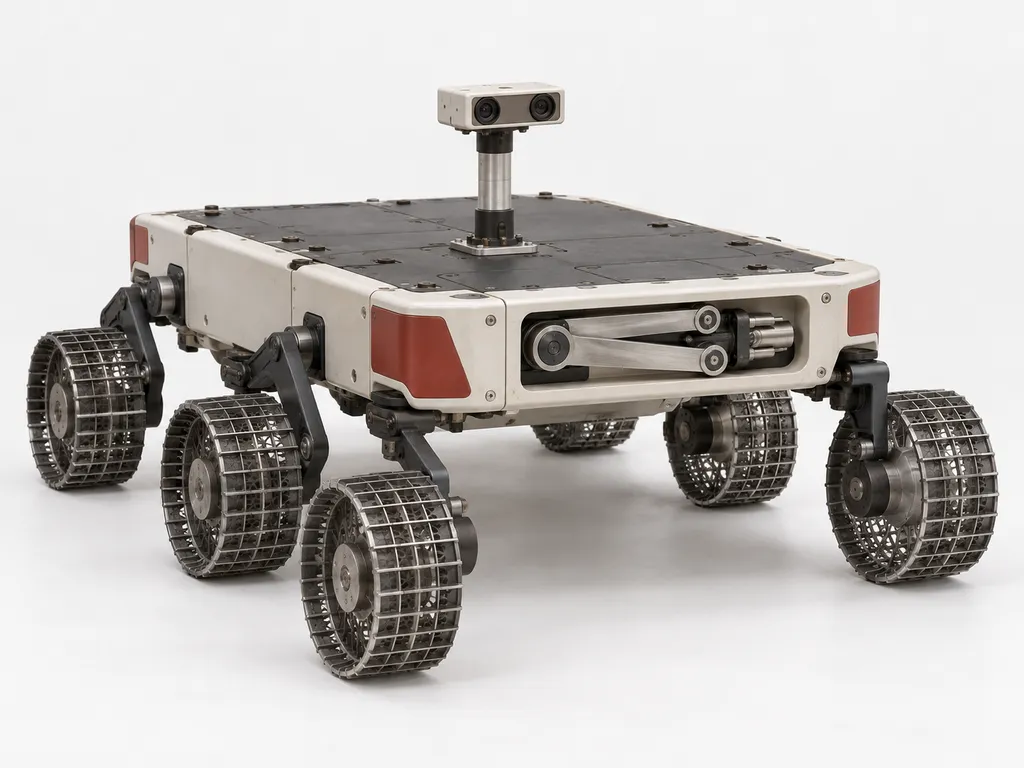
Red Horizon is a fictional, AI-assisted Mars exploration programme, and it now has its first surface vehicle design. The vehicle is RH-01 Pathfinder: a compact robotic Mars surveyor that maps local terrain, investigates rocks in context, and establishes safe routes for later science targets. Pathfinder is an instrument that has been made mobile — not a car, not a miniature tank, not a crew vehicle. The design brief it answers to is written by the planet: dust, uneven terrain, limited power, a communication delay between the rover and the people operating it, and the fact that every decision on the surface is made remotely.
What that produces is a deliberate shape. The body is a low, broad rectangular equipment housing, roughly two metres in class, with its equipment mass kept close to the chassis and its corners protected and modestly rounded. The front is the science end and carries the stowed contact arm; the rear is intentionally uneventful — a plain sealed service panel with no second arm, exhaust assembly, or cargo rack. Colour is functional rather than decorative: warm white panels with a matte, ceramic-like finish, a small number of muted red identification panels integrated into the body, and a dark, flat equipment deck on top that makes the mast mount easy to find. There are no windows, no cockpit, no exposed wiring, and no insignia — the deck is a sealed instrument surface with a few necessary mounting points, and nothing on the vehicle names an agency.
The lower structure is the part that defines the machine: exactly six broad open-mesh wheels, a front, middle, and rear pair, each with a clear circular hub and a broad perforated face over a dark inner structure. The wheels connect to the body through visible articulated suspension — links, pivots, and hubs that form continuous mechanical chains rather than isolated bars — with enough clearance to travel over small stones without the body touching the ground. The wheel count is fixed: there is no seventh wheel, no track, and no leg.
Vision comes from a short, central mast carrying one horizontal stereo-camera housing with a closely spaced pair of dark lenses. It is deliberately not a tower: there is no second camera mast, no antenna cluster, no dish, and no radar boom. Close work belongs to a single front-centre contact arm with exactly two connected joints and one small contact tool. In its travel configuration the arm nests inside a shallow cradle built into the front body, the tool secured within it and the whole assembly kept below the height of the mast base — a practical restraint that protects the arm while the rover drives.
The materials read as a field machine rather than a showpiece: matte ceramic-coated panels, subdued brushed metal on the arm, dark protected pivots, durable wheel mesh, and small recessed fasteners. In its baseline configuration the vehicle is clean and new, with no accumulated dust, impact damage, or dramatic wear. That is the engineering-reference appearance the design dossier documents: the vehicle on a neutral white floor with a white background, under broad soft light, with a faint grounded shadow.
That appearance will not stay clean. The design defines four operating stages — baseline; early surface operations, with restrained dust and short wheel tracks; mature operations, with accumulated dust and faded paint; and late mission, when wear reflects the rover’s operational history while the maintained machine remains recognisable and functional. The stages describe how the vehicle is expected to age, not events that have happened.
The science role is observational and methodical. Pathfinder carries the payload scope the programme agreed in its second public step: panoramic and navigation imaging, local weather observation, mineral and rock-context sensing, and the close-contact tool. It works in short, deliberate traverses — survey the terrain, select a target, approach it, observe, record, and choose the next safe route — and it gathers evidence before an interpretation is made.
One caution belongs in the same breath as the design: describing a fixed design is not the same as having built one. No launch vehicle has been named, no launch date has been stated, and no landing site has been announced. The rover design is settled; the mission around it is still being assembled.
Red Horizon is a fictional, AI-assisted Mars exploration programme. RH-01 Pathfinder is a fictional vehicle, described here from the programme’s own design dossier, and the studio views of it are illustrative artwork; no real space agency is named or implied.