
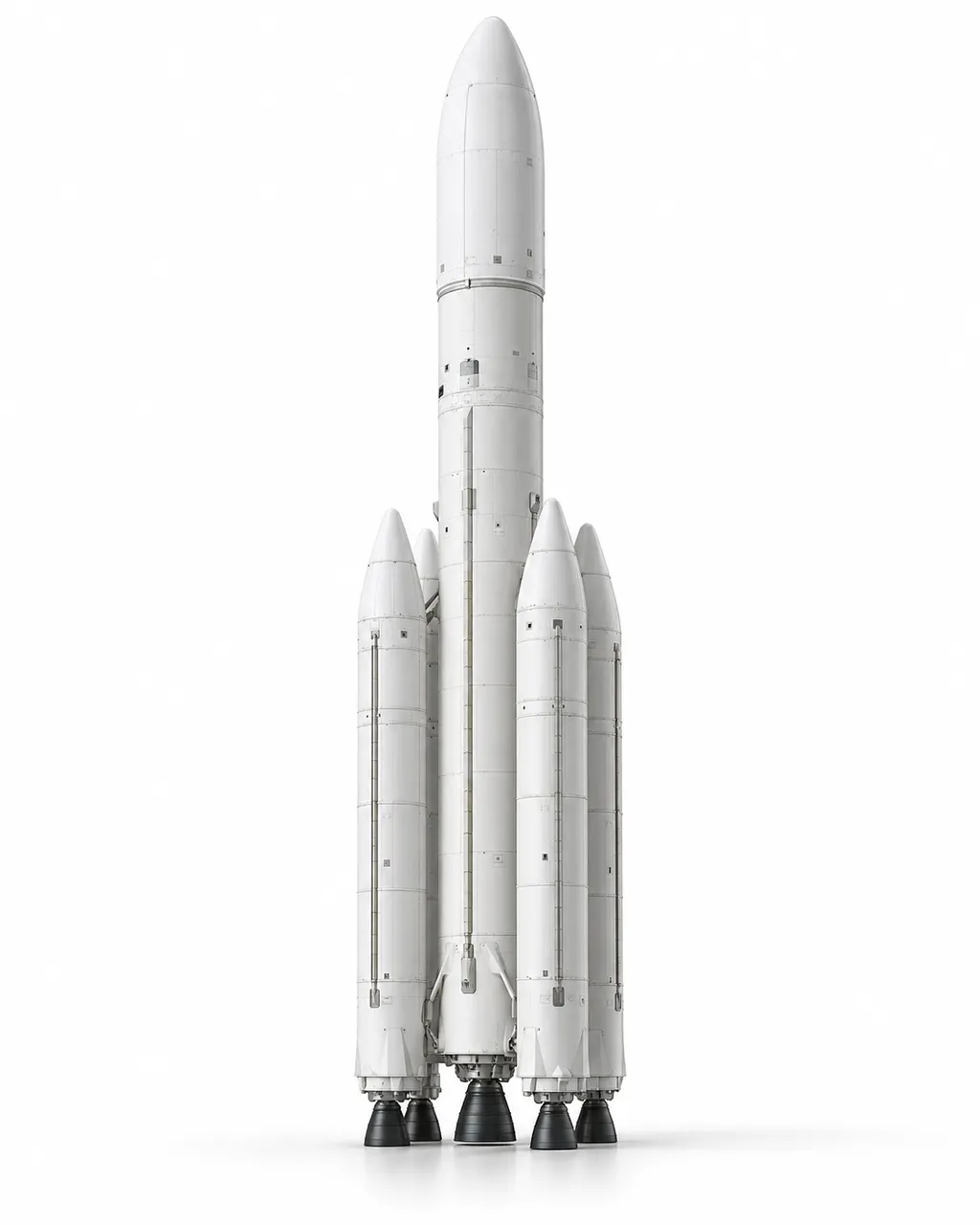
Red Horizon is a fictional, AI-assisted Mars exploration programme, and it has now decided how Red Horizon One will leave Earth. The programme has selected a delivery architecture for the mission: a launcher for the flight stack, a cruise stage for the transfer to Mars, a communications plan, and a high-level concept for entry, descent, and landing. This is a decision about a design, not a promise about a date. No launch day or time has been announced, and no part of the flight stack has been integrated with a launcher or delivered to a launch site.
The launch vehicle is Ariane 64, the four-booster variant of the Ariane 6 launcher family. Ariane 64 is a real vehicle; naming it here says which launcher this fictional mission is planned around, and nothing more. Its record belongs to the organisations that build and operate it, not to Red Horizon, and no real agency, launcher operator, or launch facility is a partner in this programme or has endorsed it. The programme itself owns one part of that arrangement: its interface to the launcher.
That interface is an injection and payload-adapter segment. The adapter is the mechanical and electrical interface between the flight stack and the launch vehicle; injection is the point at which the stack separates and is placed on a transfer trajectory towards Mars. Everything from that separation onwards is the mission’s own architecture: a solar-powered cruise stage for navigation, thermal control, and communications with Earth; a lander platform that performs entry, descent, and landing; and RH-01 Pathfinder, the six-wheel rover the mission carries to the surface.
The lander platform enters the Martian atmosphere, deploys a supersonic parachute, uses terrain-relative navigation to compare the ground below with the terrain its guidance expects, and finishes the descent on a throttleable engine stage. It then stays where it lands and becomes the mission’s relay: the rover talks to the platform over a short-range radio link, and the platform returns that data to Earth over a steerable X-band downlink. The rover keeps its own low-rate direct-to-Earth link for health reports and commands. Red Horizon includes no dedicated programme orbiter, so the architecture brings its own relay rather than borrowing one.
Two facts about the mission shape the choice. The whole flight stack travels on one launch, so the architecture is built around what a single vehicle can carry — cruise stage, lander, and rover leaving Earth together — rather than around spacecraft meeting in Mars orbit. And the science happens on the surface, so the job of getting to Mars and the job of getting down to it sit in separate elements. The mission is uncrewed, so nothing in the architecture carries or supports people.
The schedule frame remains the 2031 launch window set out in the programme announcement, and no day within it has been announced. What sits between this decision and the flight is integration and readiness work: bringing the elements together into one stack, testing that stack and its parts against the conditions the mission will face, and closing the reviews that establish the mission is ready to fly. The programme has published a decision, not a countdown.
Red Horizon is a fictional, AI-assisted Mars exploration programme. Ariane 64 is a real launcher designation, cited here to describe the architecture this fictional mission is planned around; no real agency, launcher operator, or launch facility is a partner in Red Horizon, and none of them has endorsed or approved it.