
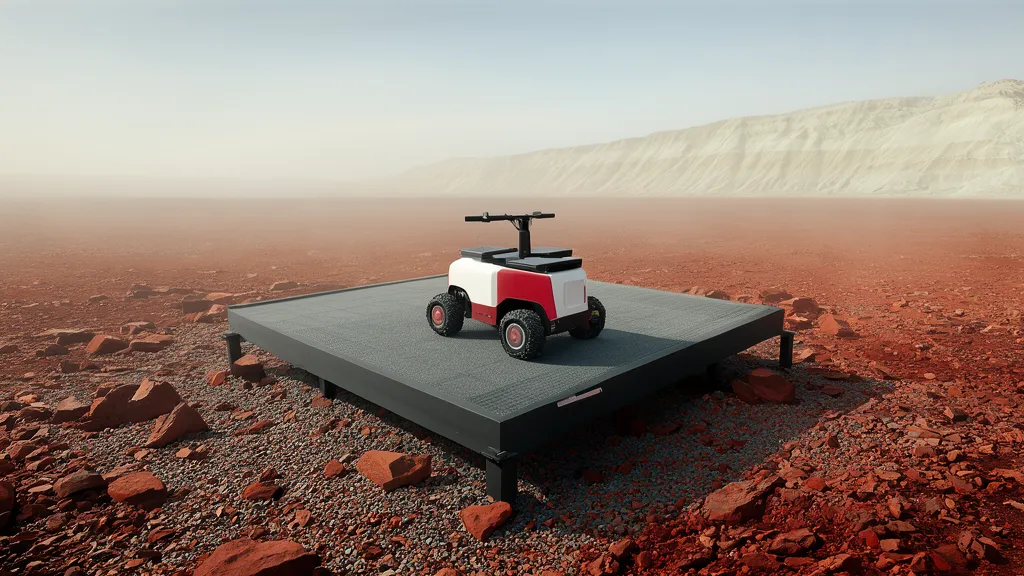
Landing confirmed at Asteria Field
Red Horizon is a fictional, AI-assisted Mars exploration programme, and the programme reached the milestone recorded for 16 September 2031. On that date, Red Horizon One — launched 17 February 2031 aboard Ariane 64 and now in cruise since the mission’s mid-course corrections — entered the Martian atmosphere and confirmed landing at Asteria Field, the mission’s destination. The final approach correction update closed the cruise record with the acknowledgement that details of entry, landing, or surface operations were not part of that record; this update marks where the landing record begins.
What is confirmed
The first confirmations from the surface are the ones the programme considers the foundation of a successful landing: power is established, communications with Earth through the relay architecture are stable, and the rover is alive and responding. These three factors — power, communications, and the rover responding — are what the programme reports before describing the landing as successful. The launch architecture update describes the relay framework the mission relies on: the platform stays where it lands and returns data to Earth over a steerable X-band downlink, while the rover communicates over a short-range link and maintains a low-rate direct-to-Earth health connection.
What remains to be checked
Before the mission can describe the surface phase as fully underway, several items remain to be checked. Commissioning of the rover’s instruments and systems is the first step; sensors will be assessed next; and the ramps will be checked before the rover leaves the platform. The local environment must also be assessed before any surface activity proceeds. These items are reported as a checklist of what comes next, not as results — the programme is still in the earliest hours of its surface life.
First expected surface operations
The first expected surface operations follow the released mission architecture. Before the rover leaves the platform, platform and system checks are carried out. The Asteria Field wiki and the RH-01 Pathfinder entries describe the released vocabulary for this phase: the rover is carried to the surface and the plan is for it to deploy from the platform when the checks are complete. No surface activity beyond those checks is reported here.
An open question
Whether the commissioning sequence will complete entirely on the nominal plan remains an open question, and the programme will report on how it develops in its next record. The final approach update closed the cruise phase by noting that entry, landing, and surface operations would be reported in due course; that reporting now begins with this update.
What the record covers
This record covers the confirmed landing at Asteria Field on 16 September 2031 and the immediately following commissioning period. Later surface milestones belong to subsequent updates that have not yet been released.
Ariane 64 is a real launcher designation; naming it here says which launcher this fictional mission is planned around, and nothing more. The launch update records the mission’s departure aboard it. Its record belongs to the organisations that build and operate it, not to Red Horizon, and no real agency, launcher operator, or launch facility is a partner in this programme or has endorsed it.
Red Horizon is a fictional, AI-assisted Mars exploration programme. Ariane 64 is a real launcher designation, cited here to describe the architecture this fictional mission is planned around; no real agency, launcher operator, or launch facility is a partner in Red Horizon, and none of them has endorsed or approved it.