
Ariane 64
Four-booster Ariane 6 variant: Red Horizon One's launch vehicle; injection and payload-adapter interface placing the flight stack on its Mars trajectory.
Identity and name
The launch vehicle documented here is the Ariane 64. It is the four-booster variant of the Ariane 6 launch-vehicle family. The vehicle designation is the public string the programme names when it names its launcher, and it is the single token that identifies the already released architectural choice behind Red Horizon One.
Ariane 64 is a real launch vehicle. Naming it here states which launcher this fictional mission is planned around, and nothing more. Its record belongs to the organisations that build and operate it, not to Red Horizon, and no real agency, launcher operator, or launch facility is a partner in this programme or has endorsed it. The programme itself owns one part of that arrangement: its interface to the launcher.
Four-booster configuration
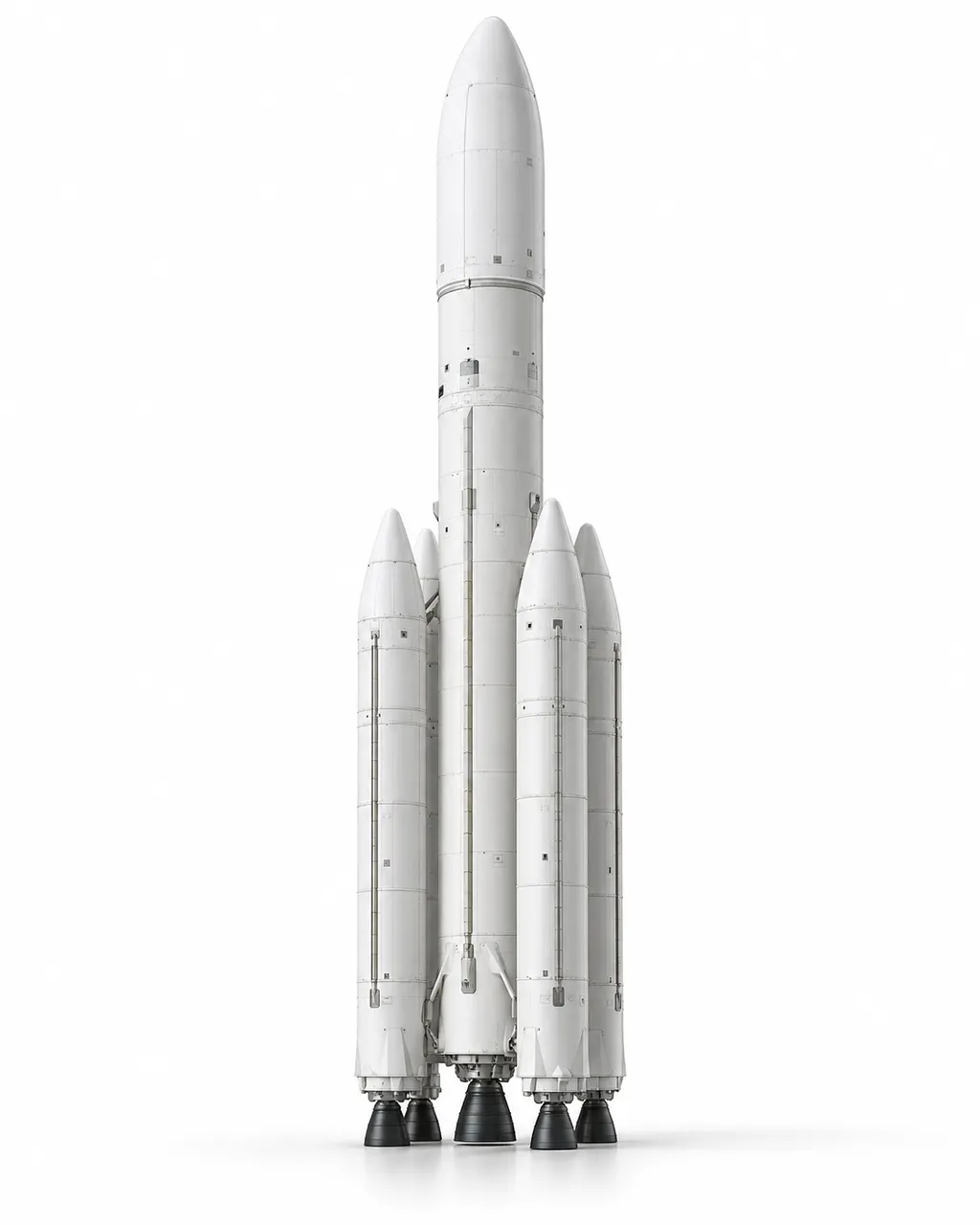
The Ariane 64 is distinguished from the two-booster Ariane 62 by its four solid rocket boosters. They are arranged two on each side of the central core, top and bottom on each side, giving the vehicle its square cross-section at the booster attach points and its rectangular outline at lift-off. The configuration is single-stick: one core, four strap-on boosters, no additional core, no cross-feed.
The central core is a single liquid-hydrogen / liquid-oxygen stage with the Vulcain 2.1 main engine. Above the core sits the upper stage with the Vinci engine, and above that the payload fairing and the payload adapter that carries the spacecraft stack. The four solid rocket boosters are visible from below as the most prominent external feature of the lift-off silhouette: smooth white cylinders similar in diameter to the core, each with a single nozzle at its base aligned with the core nozzle.
The Ariane 64 is not crew-rated and not reusable. It has no crew access arm, no launch-escape system, no crew capsule, and no life-support hardware; it is an uncrewed heavy-lift launcher for automated payloads. The core stage, the upper stage, and the solid rocket boosters are all expended.
Role in the flight stack
The Ariane 64 is the first element of the Red Horizon One flight system. It places the cruise stage onto the Earth-departure trajectory that carries the mission toward Mars. The four other elements of the flight system — the cruise stage, the aeroshell and powered stationary landing platform, RH-01 Pathfinder, and the ground and relay segment — are downstream of the launcher and depend on it only through the launch-vehicle interface.
The Ariane 64’s role is limited to the first few minutes of the mission: lift-off, ascent, fairing jettison, and injection onto the outbound trajectory. Once the cruise stage separates, the launcher has no further role. The cruise stage handles navigation, thermal control, and Earth communications; the landing platform handles entry, descent, landing, rover deployment, and surface relay; RH-01 Pathfinder handles the surface science campaign.
Interface to the programme’s payload
The programme’s interface to the Ariane 64 is the payload-adapter and injection-segment framing established in the programme’s design dossier. The interface is what the spacecraft stack sees at the moment of separation, and it is the only point where the launcher and the mission touch.
The four elements of the interface are:
- Payload adapter. A standard mechanical interface between the Ariane 64 upper stage and the cruise stage. The adapter transmits launch loads and separates cleanly on command once the upper stage reaches the right point on the outbound trajectory. The cruise stage treats the adapter as a single attachment point and does not see the rest of the launcher.
- Injection segment. The portion of the ascent that places the spacecraft stack on the Earth-departure trajectory. The upper stage performs the final injection burn after fairing jettison; the cruise stage separates once the trajectory is correct. The injection segment ends at separation, and the launcher has no further role.
- Target mass. The target spacecraft mass at launch-vehicle separation is a programme-controlled mass ceiling, not a launcher performance figure. It is what the mission design protects, not what the launcher is contracted to deliver.
- Integration campaign. The programme-side process that delivers the spacecraft stack to the launch site, integrates it with the launcher, and supports it through launch. The campaign is a fictional programme activity: it does not name a real launch facility, a real operator, or a real integration team.
The launch window itself — a 2031 window, as released by the programme’s announcement — is the only calendar information the programme’s public record carries from the launcher dossier.
Visual identity
The Ariane 64 silhouette is defined by the four-booster configuration: a central core stage flanked by four solid rocket boosters, a Vulcain 2.1 main engine on the core, and a payload fairing on top. The vehicle is tall and slender, with a white body — white core, white boosters, white fairing — and the dark Vulcain 2.1 nozzle and the dark upper-stage Vinci nozzle as the only large dark features. Markings are small and technical: panel boundaries, separation plane lines, and small technical labels in restrained positions. There are no decorative graphics, no painted mascots, no national flags, no large logos, and no bold accent colours.
The approved engineering-reference plate shows the full-size launcher on a seamless neutral white floor with a white background, broad soft light, and a faint grounded shadow: an engineering reference appearance with no launch tower, no service gantry, no mobile gantry, no crew, no smoke, no plume, no flame, no integration equipment, and no launch-site infrastructure.
Related records
The programme’s published technical decisions on the launch architecture are carried by these records:
- The launch architecture briefing — how the flight stack is planned to reach Mars, and the interface the programme owns.
- The programme overview — the mission’s purpose, the coalition, and the schedule and budget frames.
- The rover design — RH-01 Pathfinder, the mission’s surface vehicle.
- The landing zone — the fictional operational region the mission targets.