
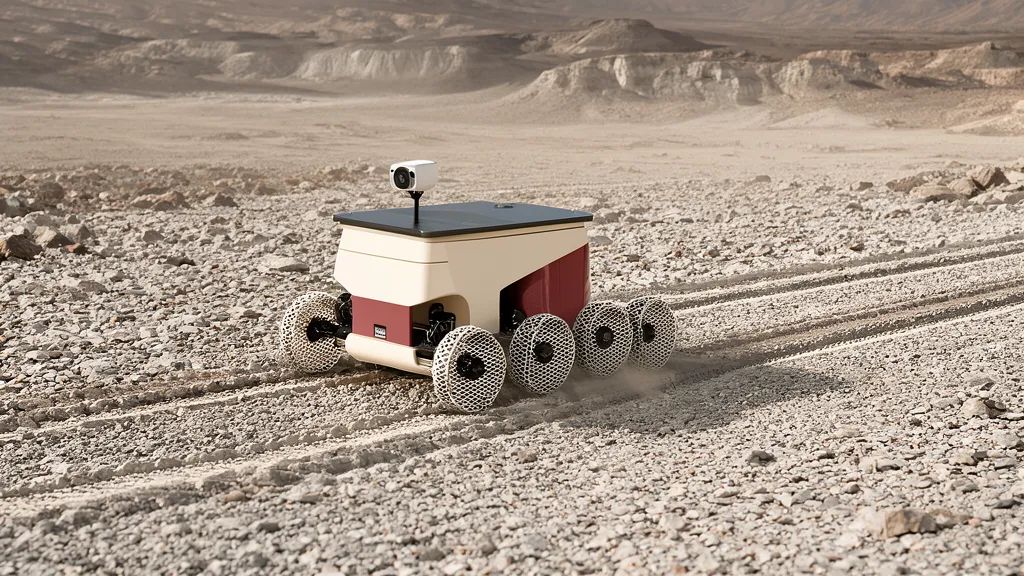
RH-01 completes its first controlled drive
Red Horizon is a fictional, AI-assisted Mars exploration programme, and the programme has reached the milestone recorded for 30 September 2031. On that date, Red Horizon One — which landed at Asteria Field on 16 September, as the landing confirmation update recorded, and which egressed from its landing platform on 23 September, as the egress update reported — completed the first controlled drive and the mobility assessment that followed it.
The first controlled drive is the rover’s first commanded, measured movement across the surface. The mobility assessment checks how the rover moves over the local terrain. Together, these milestones close the commissioning sequence that the egress update set in motion: “The next step is measured movement testing. No drive distances have been recorded yet, and commissioning continues.” That promise is now met.
The drive
On 30 September 2031, RH-01 carried out a short measured movement across the local terrain at Asteria Field. The movement was deliberate and commanded: the rover moved a short distance on the surface, testing how its mobility system performs in the released environment. This is a commissioning and mobility-assessment event, not a science traverse — no target approach, no contact tool deployment.
The RH-01 Pathfinder entry describes the six-wheel mobility system that performed the drive: six broad open-mesh wheels arranged in a front, middle, and rear pair on each side, connected by visible articulated suspension that gives enough clearance to pass over small stones without the body resting on the ground. The first drive exercised that released six-wheel system on the surface, confirming that the six-wheel geometry and suspension work as designed for local-terrain movement.
Mobility assessment
The mobility assessment followed the drive and checked how the rover moves across the local terrain at Asteria Field. The assessment confirmed that the movement tests are consistent with the released design: the vehicle design update describes the rover as working in short, deliberate traverses, where the team surveys the terrain, selects a target, approaches it, observes, records, and chooses the next safe route. The assessment confirms that the six-wheel system handles the Asteria Field surface under the released constraints — limited power, uneven terrain, and the communication delay that means every decision on the surface is made remotely.
The Asteria Field entry describes the regional setting in which this testing took place. The terrain vocabulary released for Asteria Field — rocks, dust, and layered outcrops — is what the mobility assessment evaluated against.
Landing-era condition at the observable level
The commissioning sequence did not complete entirely on the nominal plan. A minor landing-era condition is observable, and the team continues to monitor it. The condition does not prevent basic science or short traverses, and the team is tracking how it develops. No diagnosis is offered at this stage; the programme reports what is observable and continues to assess.
This resolves the open question raised in the landing confirmation update and the surface panorama update: whether the commissioning sequence would complete entirely on the nominal plan. At the released observable level, the sequence has reached its mobility assessment milestone and the programme is continuing.
What comes next
The first controlled drive and mobility assessment are complete, and RH-01 is on the surface at Asteria Field. The RH-01 Pathfinder entry and the vehicle design update describe the released operations model for what follows: short, deliberate traverses to put instruments in front of the right ground. Later surface milestones belong to subsequent updates that have not yet been released.
Ariane 64 is a real launcher designation; naming it here says which launcher this fictional mission is planned around, and nothing more. The launch update records the mission’s departure aboard it. Its record belongs to the organisations that build and operate it, and no real agency, launcher operator, or launch facility is a partner in this programme or has endorsed it. The Red Horizon programme entry describes the released framework for this mission.
Red Horizon is a fictional, AI-assisted Mars exploration programme. Ariane 64 is a real launcher designation, cited here to describe the architecture this fictional mission is planned around; no real agency, launcher operator, or launch facility is a partner in Red Horizon, and none of them has endorsed or approved it.