
First surface panorama and engineering health packet
Red Horizon is a fictional, AI-assisted Mars exploration programme, and the programme has reached the milestone recorded for 17 September 2031. On that date, Red Horizon One — which landed at Asteria Field the previous day, as the landing confirmation update recorded — completed the first step of its surface phase: the engineering health packet returned, and the first panoramic image from the rover’s mast cameras is now available.
What the health packet tells us
The engineering health packet — the rover’s own summary of how its systems are doing — has reached the team through the relay architecture the launch architecture update describes: the platform stays where it landed and returns data to Earth over a steerable X-band downlink, while the rover communicates over a short-range link and maintains a low-rate direct-to-Earth health connection. The packet confirms that power, communications, and the rover’s core systems are functioning as expected after landing.
First surface panorama
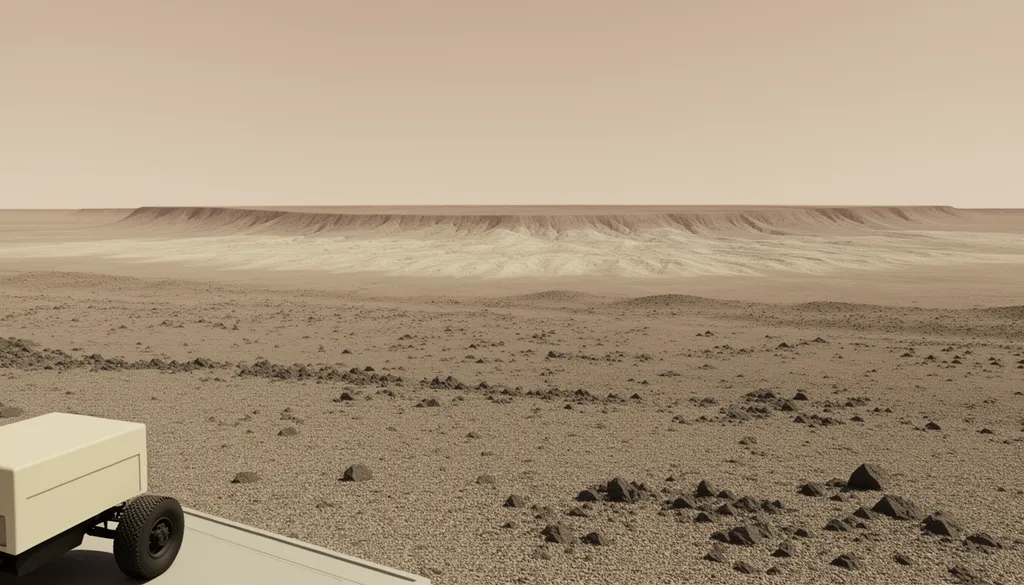
The first panoramic image from the rover’s mast cameras is available, and it establishes the terrain scale and operational reality the mission will be working in. The panorama shows rocks, dust, and layered outcrops in the surrounding environment, seen from mast height while the rover remains on the landing platform. A panorama puts a target in context, and this first one shows where the mission’s future work will take place against the layered terrain of the Asteria Field region.
The image is an illustrative panorama of the fictional mission’s landing terrain, not mission photography. It was generated to depict the released regional-setting vocabulary — the cratered basement, the basin-margin material as laterally persistent, finer-grained layers, and the channel and bench surfaces that the Asteria Field entry describes.
Mast and core sensors check out
Mast and core sensors have checked out. The stereo cameras on the short, central mast are imaging as planned, navigation imaging is functional, and the environment and weather sensors are reporting. This assessment covers the released payload scope — panoramic and navigation imaging, environmental measurement, and rock sensing — and confirms that the rover’s instrument suite is ready for the next phase of commissioning.
What comes next
Commissioning continues before any movement. The ramps will be checked before the rover leaves the platform, and the local environment must be assessed before surface activity proceeds. The RH-01 Pathfinder entry and the vehicle design update describe the released vocabulary for this phase: the rover is carried to the surface and is planned to deploy from the platform when the checks are complete. Later surface milestones belong to subsequent updates that have not yet been released.
Whether the commissioning sequence will complete entirely on the nominal plan remains an open question, and the programme will report on how it develops in its next record.
Ariane 64 is a real launcher designation; naming it here says which launcher this fictional mission is planned around, and nothing more. The launch update records the mission’s departure aboard it. Its record belongs to the organisations that build and operate it, not to Red Horizon, and no real agency, launcher operator, or launch facility is a partner in this programme or has endorsed it. The Red Horizon programme entry and the Ariane 64 entry describe the released framework for this mission.
Red Horizon is a fictional, AI-assisted Mars exploration programme. Ariane 64 is a real launcher designation, cited here to describe the architecture this fictional mission is planned around; no real agency, launcher operator, or launch facility is a partner in Red Horizon, and none of them has endorsed or approved it.