
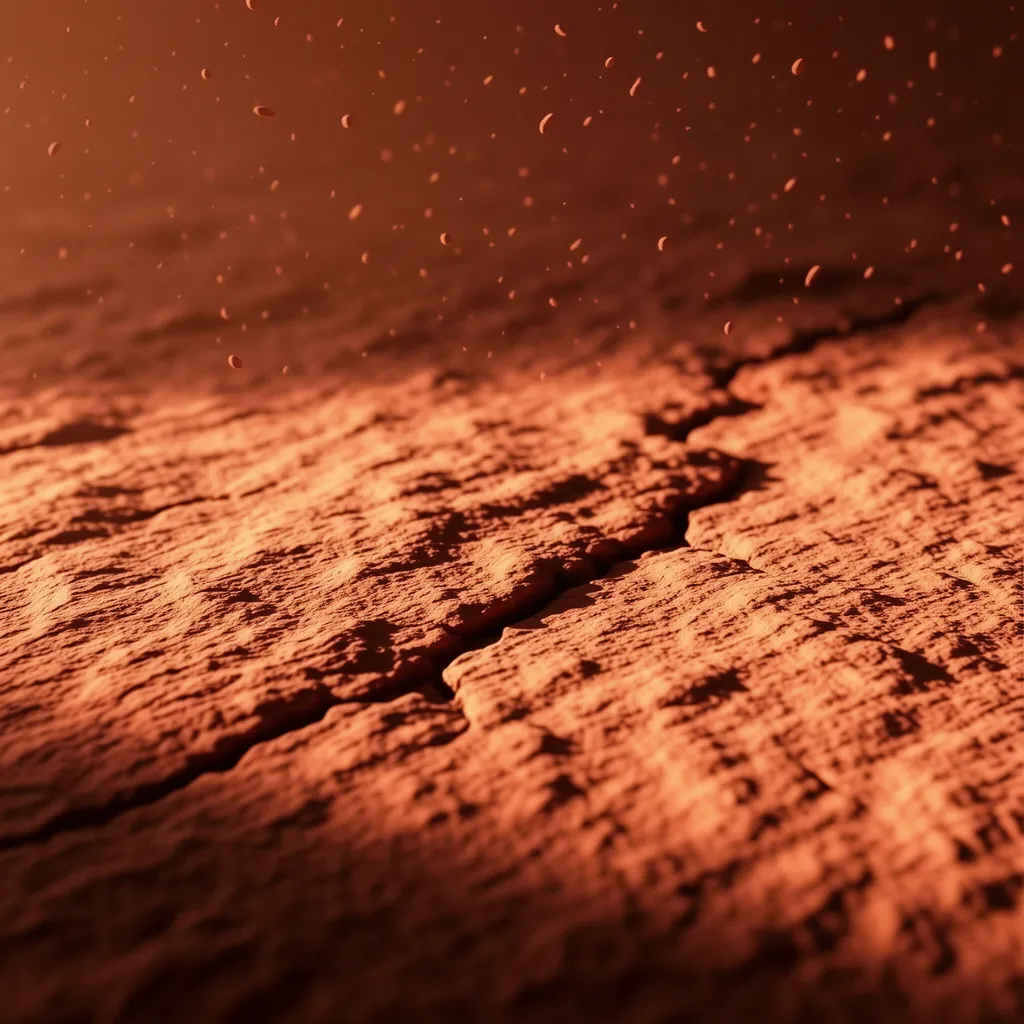
Red Horizon collects its first onboard sample
Red Horizon is a fictional, AI-assisted Mars exploration programme, and the programme has reached the milestone recorded for 31 October 2031. On that date, Red Horizon One — which landed at Asteria Field on 16 September, as the landing confirmation update recorded, which egressed from its landing platform on 23 September, as the egress update reported, and which completed its first controlled drive on 30 September, as the first drive update confirmed — carried out the first onboard sample collection and mineral analysis of the mission.
The first onboard sample is a portion of Martian material collected locally by the rover and analysed on Mars inside its own tool — never sent elsewhere. The mineral analysis is the spectral and compositional reading of that material. Both terms are defined plainly here, because this page is the first public record in which they appear.
This milestone is the record the first drive update promised: “Later surface milestones belong to subsequent updates that have not yet been released.” It also resolves the explicit state recorded there — “This is a commissioning and mobility-assessment event, not a science traverse — no target approach, no contact tool deployment” — for the contact tool is deployed here for the first time and a sample is taken.
The first sample
On 31 October 2031, RH-01 used its contact tool to abrade a weathered surface at Asteria Field. The contact tool is a close-inspection instrument at the end of the rover’s front-centre arm; the RH-01 Pathfinder entry describes the arm as having exactly two connected joints and ending in one small contact tool. Abrading the surface prepares it for analysis by removing the outer layer of dust and weathered material.
From the abraded surface, the rover captured no more than one cubic centimetre of loose material — an upper bound on the amount collected, not a measured volume — and analysed it inside the tool’s reusable chamber. The chamber is designed to repeat the process over the course of the mission, so “reusable” means the tool carries out this analysis again and again rather than once.
The material was then returned to the ground near its source. In public language, “sample” always means a locally collected and onboard-analysed portion of Martian material. No sample is kept sealed, held for return, or sent to Earth.
Mineral analysis
The spectral and compositional reading of the collected material was reported at a cautious level, consistent with the released approach for this mission: the analysis is presented as what it suggests, not as a final determination. The spectrum is consistent with the mineral composition expected from the weathered terrain at Asteria Field, and the team is checking the result against further observations.
This cautious framing reflects the mission’s standing approach to mineral detection — the Asteria Field entry establishes that no target there is described as confirmed clay, confirmed sulfate, habitable, or fossil-bearing, and the payload selection update records that Red Horizon One is not a life-detection mission and carries no experiment designed to prove that life exists or existed on Mars. The result is one collected sample analysed in a single session.
Landing-era condition at the observable level
The commissioning sequence did not complete entirely on the nominal plan. A minor landing-era condition is observable, and the team continues to monitor it. The condition does not prevent basic science or short traverses, and the team is tracking how it develops. No diagnosis is offered at this stage; the programme reports what is observable and continues to assess.
The first drive update already released this qualifier and resolved the open question about whether commissioning would complete entirely on the nominal plan. The sample collection is basic science under that same released level — the team monitors the condition and continues to proceed.
What comes next
The first onboard sample collection and mineral analysis are complete, and RH-01 is operating at Asteria Field. The RH-01 Pathfinder entry and the vehicle design update describe the released operations model for what follows: short, deliberate traverses to put instruments in front of the right ground, with each target approached, observed, recorded, and then the next safe route chosen. Further samples and observations belong to subsequent updates.
The Asteria Field entry describes the regional setting in which this work takes place, and the Red Horizon programme entry describes the released framework for the mission overall.
Ariane 64 is a real launcher designation; naming it here says which launcher this fictional mission is planned around, and nothing more. The launch update records the mission’s departure aboard it. Its record belongs to the organisations that build and operate it, and no real agency, launcher operator, or launch facility is a partner in this programme or has endorsed or approved it. The Red Horizon programme entry describes the released framework for this mission.
Red Horizon is a fictional, AI-assisted Mars exploration programme. The real-world sources cited on the payload selection update describe the general class of technique this mission employs; no real institution is a partner in Red Horizon, and none of them has endorsed or approved it.