
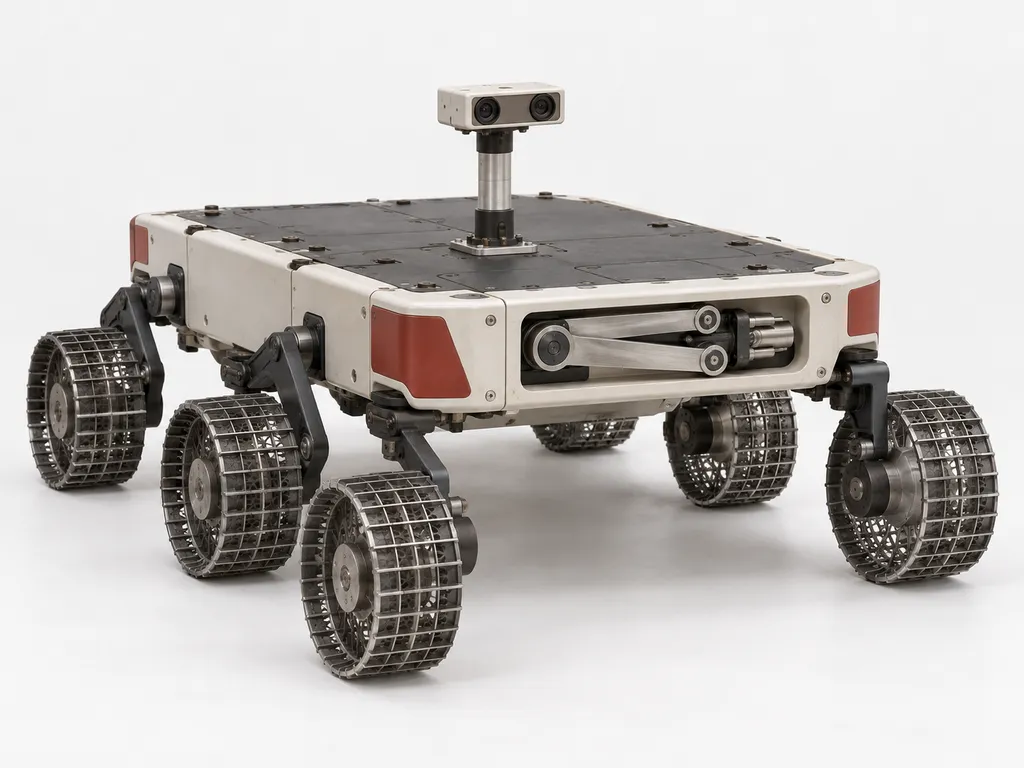
Red Horizon marks one Mars year on the Martian surface
Red Horizon is a fictional, AI-assisted Mars exploration programme, and the programme has reached the milestone recorded for 3 August 2033. On that date, RH-01 — which landed at Asteria Field on 16 September 2031, as the landing confirmation update recorded, which egressed from its landing platform on 23 September, as the egress update reported, and which collected its first onboard sample on 31 October 2031 and completed its first mineral-stratigraphy campaign on 18 April 2032, as the first sample update and the stratigraphy update confirmed — has now completed one Mars year of surface operation.
One Mars year is one full orbit of Mars around the Sun, about 687 Earth days. The programme defined this figure publicly at its outset: a Mars year is about 687 Earth days, and the surface mission is designed to operate for two Mars years — 1,374 Earth days — providing at least one full seasonal cycle to characterise the ancient environment at Asteria Field. The milestone of 3 August 2033 is that first year completed: the record now spans a full Martian year of seasons.
Presence and durability
Completing one Mars year means RH-01 has maintained a continuous presence on the Martian surface for about 687 Earth days. The rover landed at Asteria Field, established power and communications, egressed to the surface, and has been operating there since — collecting samples, observing layered outcrops, and measuring the local environment across a full cycle of Martian seasons.
This milestone sits inside a design frame the programme already published. The surface mission is designed to operate for two Mars years and to keep working past its first year; completing one Mars year is the design’s “at least one full seasonal cycle” now achieved. The vehicle design update describes the released operating-appearance stages — baseline, early surface operations, mature operations, and late mission — as vocabulary for the wear the design provides for, not as events that have happened. The anniversary is a durability milestone measured against that frame, not a claim about the rover’s condition.
Science gathered so far
The science recorded during the first Mars year is drawn from two released milestones. The first sample update reported the first onboard sample collection and mineral analysis on 31 October 2031: the contact tool abraded a weathered surface, captured no more than one cubic centimetre of loose material, analysed it inside the tool’s reusable chamber, and returned the material to the ground near its source. The mineral analysis was presented at the cautious level the mission uses throughout — the spectrum is consistent with the mineral composition expected from the weathered terrain, and the team is checking the result against further observations.
The stratigraphy update reported the first mineral-stratigraphy campaign completed on 18 April 2032: layered outcrop observations across Asteria Field, read together with mineral and composition data into a grounded sedimentary interpretation. That interpretation carries the mission’s standing stated limitation — no target at Asteria Field is described as confirmed clay, confirmed sulfate, habitable, or fossil-bearing, and no confirmed mineral detection or confirmed ancient-lake claim is made. The result is one completed campaign of observations checked against further data, leading to a cautious interpretation.
The anniversary page does not add new science results beyond these two released records; it records the scope of what has been gathered so far under the mission’s modest, cautious approach.
Routine operations
Across the first Mars year, RH-01 has followed the released operations model: short, deliberate traverses in which the rover surveys the terrain, selects a target, approaches it, performs contact and context observations, records the results, and chooses the next safe route. Local weather observations continue, and the record now spans a full Martian year of seasons — what the environment does at the measurement point and how those conditions change over a season. Power is established and the rover’s core systems are functioning as expected.
The programme continues to monitor a minor landing-era condition that is observable; it does not prevent basic science or short traverses, and the team tracks how it develops. No diagnosis is offered at this stage; the mission reports what is observable and continues to assess.
What comes next
The first Mars year of surface operation is complete, and RH-01 is operating at Asteria Field. The RH-01 Pathfinder entry and the vehicle design update describe the released operations model for what follows: short, deliberate traverses to put instruments in front of the right ground, with each target approached, observed, recorded, and then the next safe route chosen. The Asteria Field entry describes the regional setting in which this work takes place, and the Red Horizon programme entry describes the released framework for the mission overall.
Disclosure
Ariane 64 is a real launcher designation; naming it here says which launcher this fictional mission is planned around, and nothing more. The launch update records the mission’s departure aboard it. Its record belongs to the organisations that build and operate it, and no real agency, launcher operator, or launch facility is a partner in this programme or has endorsed or approved it. The Red Horizon programme entry describes the released framework for this mission.
Red Horizon is a fictional, AI-assisted Mars exploration programme. The real-world sources cited on the payload selection update describe the general class of technique this mission employs; no real institution is a partner in Red Horizon, and none of them has endorsed or approved it.